
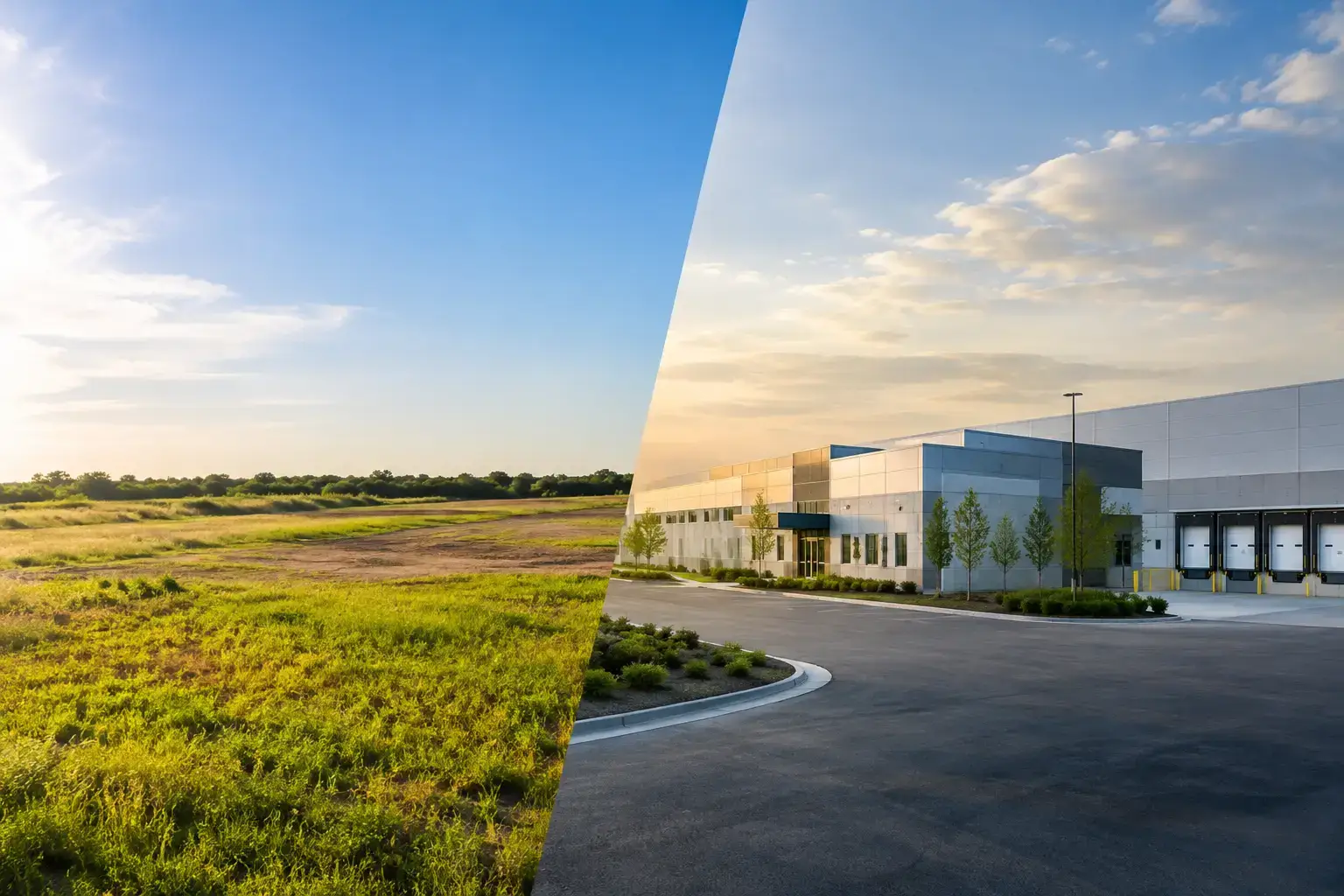
A greenfield versus brownfield facility decision is not simply a choice between building new and reusing an existing site. For a corporate occupier, it determines how much capital is committed, how quickly operations can begin, where execution risk sits, and whether the facility will support the operating model for years to come. The wrong decision can create avoidable logistics costs, workforce constraints, utility limitations, remediation exposure, or an asset that becomes obsolete before its economic life is complete.
For CFOs, executive teams, and boards, the relevant question is not which option is inherently better. The question is which option delivers the strongest risk-adjusted outcome for the enterprise’s specific demand profile, supply chain, capital plan, workforce requirements, and timeline.
Greenfield Versus Brownfield Facility: The Core Difference
A greenfield project begins on undeveloped land. The company acquires or controls the site and develops a facility designed around its operational requirements. This may include manufacturing plants, distribution centers, data centers, research facilities, service centers, or a corporate campus.
A brownfield project involves an existing building or previously developed property. The occupier may acquire, lease, renovate, expand, repurpose, or redevelop the facility. Brownfield opportunities range from an available industrial building with modest tenant improvements to a former manufacturing site requiring extensive environmental remediation and infrastructure replacement.
The distinction matters because each path allocates risk differently. Greenfield development gives an occupier more control over design, site layout, systems, expansion capacity, and operating efficiency. It also requires a greater willingness to manage entitlement, infrastructure, construction cost, and schedule risk. Brownfield facilities can shorten time to occupancy and preserve capital, but their apparent savings can disappear if due diligence fails to identify building, environmental, utility, zoning, or functional limitations.
Start With the Operating Requirement, Not the Property
Companies often begin the process with a real estate question: Should we build or buy? That is too narrow. The better starting point is an operating requirement defined in measurable terms.
For a distribution operation, that may mean required throughput, customer delivery windows, trailer parking, clear height, dock configuration, labor availability, and transportation cost. For manufacturing, it may include heavy power, water and wastewater capacity, process equipment loads, rail access, ceiling height, vibration control, hazardous-material handling, and workforce skills. A data or technology center may require redundant power, fiber diversity, cooling capacity, security setbacks, and a reliable regulatory environment.
Only after those requirements are clear can management determine whether an existing facility can meet them at an acceptable cost and risk level. A building that appears less expensive on a per-square-foot basis may require expensive modifications, operational workarounds, or recurring costs that materially weaken the business case.
When Greenfield Development Creates Value
Greenfield development is often the stronger strategic choice when the operation is highly specialized, expected to remain in place for a long period, or central to a company’s growth plan. It can allow the facility to be engineered for workflow rather than forcing operations into the constraints of a legacy structure.
This control has tangible value. A purpose-built manufacturing plant can reduce material movement, improve production flow, accommodate automation, and preserve room for expansion. A distribution center can be positioned and configured to support higher throughput, better trailer circulation, and future automation. A data center can be designed around power density and redundancy requirements that an older building cannot economically support.
Greenfield projects also create an opportunity to select the market before selecting the parcel. That sequence is essential. A site may be attractive because land is inexpensive or incentives are substantial, yet still be a poor choice if the labor market is thin, logistics costs are unfavorable, utilities cannot scale, or local entitlement processes are unpredictable.
The trade-off is execution exposure. Land acquisition, zoning, environmental review, site preparation, utility extensions, permitting, and construction all introduce variables. Construction pricing can move. Infrastructure commitments can change. Municipal approvals can take longer than represented. Incentive agreements may contain job, wage, capital investment, or operating requirements that require disciplined compliance.
A greenfield decision should therefore be supported by a realistic total project budget, a schedule with contingency, clear governance, and alternative sites or markets that preserve negotiating leverage. A low land price is not a project economics strategy.
When a Brownfield Facility Is the Better Business Decision
Brownfield facilities are often compelling when time to market matters more than perfect customization. An existing building may offer an established location, access to an experienced labor base, functioning utilities, existing transportation infrastructure, and a significantly shorter path to occupancy.
This can be particularly valuable during a capacity shortage, a market entry, a supply-chain disruption, or a consolidation where the company needs to move rapidly. In many mature industrial markets, an existing facility may also provide access to locations that cannot be replicated through greenfield development because suitable land is scarce, zoning is restrictive, or infrastructure is already fully allocated.
The financial case can be attractive as well. An occupier may avoid major sitework costs, reduce upfront capital needs, and use a lease structure to preserve balance-sheet flexibility. If the building is functionally suitable, renovation and tenant improvements may cost less and take less time than new construction.
But brownfield does not mean low risk. Older facilities can conceal deferred maintenance, roof and structural issues, obsolete fire protection, insufficient electrical service, environmental liabilities, poor energy performance, or code compliance deficiencies. A former industrial site may carry contamination risk that affects financing, insurance, redevelopment cost, and exit value. The facility’s location may be excellent while its loading configuration, parking, expansion capacity, or clear height is fundamentally inadequate.
The decision requires more than a conventional property inspection. Corporate occupiers need technical, environmental, legal, tax, operational, and financial diligence calibrated to the facility’s role. The work should establish not only what must be spent before occupancy, but what constraints and capital obligations will remain over the expected hold period.
Compare Total Occupancy Cost, Not Initial Cost
The most common analytical error is comparing a greenfield project’s development cost to a brownfield building’s purchase price or lease rate. That comparison misses the economic variables that actually determine value.
A defensible analysis should model the full cost of occupancy over the relevant decision horizon. This includes land or acquisition cost, rent or debt service, sitework, construction or renovation, tenant improvements, equipment installation, utilities, property taxes, insurance, maintenance, environmental obligations, incentives, financing costs, relocation expense, downtime, and expected exit costs.
Operating economics deserve equal attention. A lower-cost facility in the wrong location can add millions of dollars in annual freight expense. A market with insufficient skilled labor can increase wages, turnover, training expense, and production risk. Limited electrical capacity can delay an expansion or force expensive on-site generation. These are enterprise costs, not minor real estate details.
Management should also test different scenarios. What happens if demand exceeds plan? What if construction is delayed by six months? What if labor costs rise faster than projected? What if the operation is consolidated, sold, or requires a major technology upgrade? A greenfield facility may provide more adaptability, while a brownfield lease may offer better flexibility in a volatile business environment. The appropriate answer depends on the company’s strategic horizon and tolerance for irreversible capital commitments.
Incentives Should Improve the Decision, Not Drive It
State and local incentives can materially affect a facility’s economics, particularly for projects involving substantial capital investment, job creation, infrastructure needs, or redevelopment of a distressed site. Brownfield redevelopment may qualify for environmental, tax, infrastructure, or revitalization programs that are unavailable to a greenfield project. Greenfield projects may attract infrastructure grants, tax abatements, workforce assistance, or utility support in communities competing for new investment.
Those benefits matter, but they should be evaluated as a component of the business case rather than a substitute for it. Incentives with aggressive performance obligations, recapture provisions, or narrow compliance requirements can create liabilities if business conditions change. The best incentive package does not cure a market with weak labor, inadequate logistics, or unreliable utilities.
Negotiations should be integrated with site selection and transaction strategy from the beginning. Once a company signals that a location is its only viable option, leverage declines. A disciplined process maintains credible alternatives, validates public commitments, and documents each party’s obligations before the company commits capital.
Governance Makes the Difference
A greenfield or brownfield decision crosses finance, operations, supply chain, human resources, legal, tax, and real estate. When those functions work from separate assumptions, the resulting recommendation can look sound on paper and fail in execution.
Executive governance should establish the decision criteria early, assign ownership for key assumptions, and require a transparent comparison of alternatives. The board does not need a property tour. It needs a clear view of capital exposure, operating impact, downside scenarios, schedule certainty, and the consequences of being wrong.
Real Estate Strategies Corporation approaches these assignments from the corporate occupier’s side of the table. That focus matters when site selection, incentives, transaction terms, and portfolio strategy must serve the enterprise rather than a developer, landlord, or property owner.
The best facility decision is rarely the newest building or the cheapest available site. It is the option that gives the business enough capacity, flexibility, and control to execute its plan without carrying risks it cannot efficiently manage.
0 Comments